
03 July
Uncategorized
From Keywords to Intent: Why User-Focused Optimization Is the Top SEO Priority in 2025?
- admin_boi
- 0 Comments
Key Takeaways
|
Blog Audio
An effective SEO strategy addresses three key challenges: keyword classification, content alignment with user’s needs, and providing value to user.
Advanced Google AI Algorithms haven’t just changed the game; they have changed the entire playground.
Google dominates the global search engine market by an undisputed market share of 87% to 90%. So, our study primarily focuses on Google. The internet behemoth is largely run by carefully calibrated algorithms, whose primary job is to sift data according to Google’s numerous guidelines and direct the traffic of billions of search queries generated every day to their intended destination.
It’s not surprising that these complex algorithms make numerous decisions each day, and any of these decisions may result in catastrophic losses or sudden windfalls for your business’s online revenue generation. Yet, Google SERP results aren’t a gamble or a lottery; they’re just an efficient way Google manages the huge data flow while ensuring relevancy. So, this article aims to help your business navigate the challenges presented by the internet’s evolving dynamics.
Remember: Your business is a ship in the sea of the internet. Your website’s technical aspects are your ship’s engine, your content strategy is your propeller, and user-focused SEO is the rudder.
Why SEO is the key strategy for online success?
There are some hard facts that every business/brand must face:
- More than 90% of Google searches end on the 1st page of Google results. (Source)
- Only 9% of Google searchers make it to the bottom of the first page of search results.(Source)
- Only 0.44% of searchers go to the second page of Google’s search results. (Source)
These facts demonstrate why ranking higher on SERPs is the top priority for any business. A popular joke within the SEO community is that the 2nd page of Google is the best place to hide a dead body.
While it’s true that no single entity can dominate the search engine results for highly competitive keywords (given the huge competition, multiple parameters, and changing algorithms at work), it’s entirely possible that some of your webpages rank high in SERP for unique keywords related to your domain. Once they bring relevant traffic to your website, the game is half won.
The tool that makes this possible is Search Engine Optimisation Strategy. It is the foundation of business visibility, digital reach, and impactful marketing in a highly dynamic and competitive field of Search Engine discovery.
The competition isn’t going away anytime soon; it’s likely to increase as more businesses and brands strive to establish a stronger online presence. To fight this battle, one of the biggest weapons you have is a well-researched keyword strategy that directs your content generation and keeps you relevant on the internet.
Help from the best SEO Consultant in India is just a click away. Explore our affordable service plans to learn more about how we can help you excel in the SEO game.
As Google makes continuous improvements in its ML-NLP algorithm (Machine Learning and Natural Language Processing (NLP) Algorithms), your keyword strategy also needs to evolve. This is where the concept of a User-Focused SEO strategy becomes highly relevant.
Evolution of SEO Strategy to User-Focused SEO Strategy
Despite the multimedia and multimodal nature of the internet today, words (written or spoken) remain the primary tools of internet navigation. This makes keyword-led SEO strategy a core part of marketing and SERP initiatives.
Until 2013, the primary strategy for most businesses online was to include as many keywords as possible in their content, as Google algorithms simply crawled and indexed webpages based on keyword matching. The more keywords your web content has, the higher the chances of appearing in search results. However, this gave rise to the keyword-trapping phenomenon, where website content was stuffed with irrelevant keywords out of context to rank higher.
Between 2013 and 2019, Google made significant changes to its ranking and search algorithms, enabling it to find and prioritize relevant sources. The new paradigm focused on delivering highly accurate and relevant results based on the concept of ‘contextual interpretation of search queries.’ Google’s new ML-NLP-based algorithms were advanced enough to accomplish this, and this heralded a significant shift in SEO strategy development.
This brings us to the current decade, where SEO strategies have become more nuanced and expanded to include concepts like Content Quality Ratings, NLP-based contextual analysis, AI retrieval strategies (making your content suitable for AI mentions), and satisfying increased user expectations. Another major element among this list is intent modelling, which is the foundation of user-intent-based SEO strategies.
What’s the difference between new and old SEO Strategies?
Under the old SEO strategy, webpages aimed to host content that targeted the search engine crawlers through the fundamentals of keyword-centric SEO. Now, since Google has firmly established its faith in the principle of ‘value for user’ concept, page content is expected to add value to the user’s life, rather than game the search engine with technical strategies. This is achieved by optimizing your on-page content to fulfill user expectations. A key part of this approach is to identify the search intent/user intent of your target groups and create content (such as listicles, ads, how-to content, guides, data, and answers to queries) that fulfills these search intents.
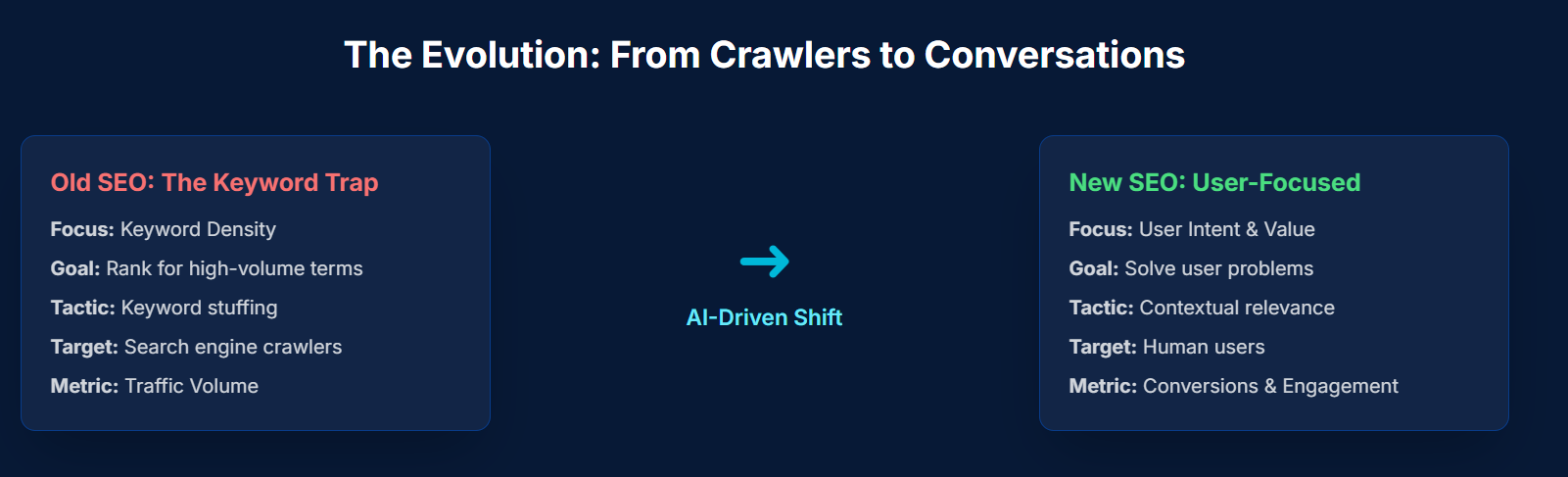
Let’s say a user searches for ‘Places to Visit in Amsterdam.’ They want to see a list of places they can visit while in the city, not to be bombarded with Amsterdam tourist packages and tour brochures.
One key observation is that with changes that came with Google’s user-centric policy and automated ranking system, SEO strategy has become more impactful in delivering results, if done correctly. The availability of AI tools for users is indeed creating demand for digital strategists to diversify their content strategy, but the fundamental role of SEO strategy remains the same. All that has changed is the way users interact with content and their expectations of the internet.
Many businesses are already aggressively modifying their SEO strategy to adapt to these changes. The two main components of this plan of action are “User-Intent Optimization ” and “AI-Powered SEO.” They address the same challenge of search engine ranking, and thus are indispensable to developing a robust SEO Strategy in 2025.
Check out our technical SEO Services to know more about how we can help you transform your SEO Strategy and make your online presence future-proof.
A. Why is a User-Focused SEO Strategy Crucial in 2025?
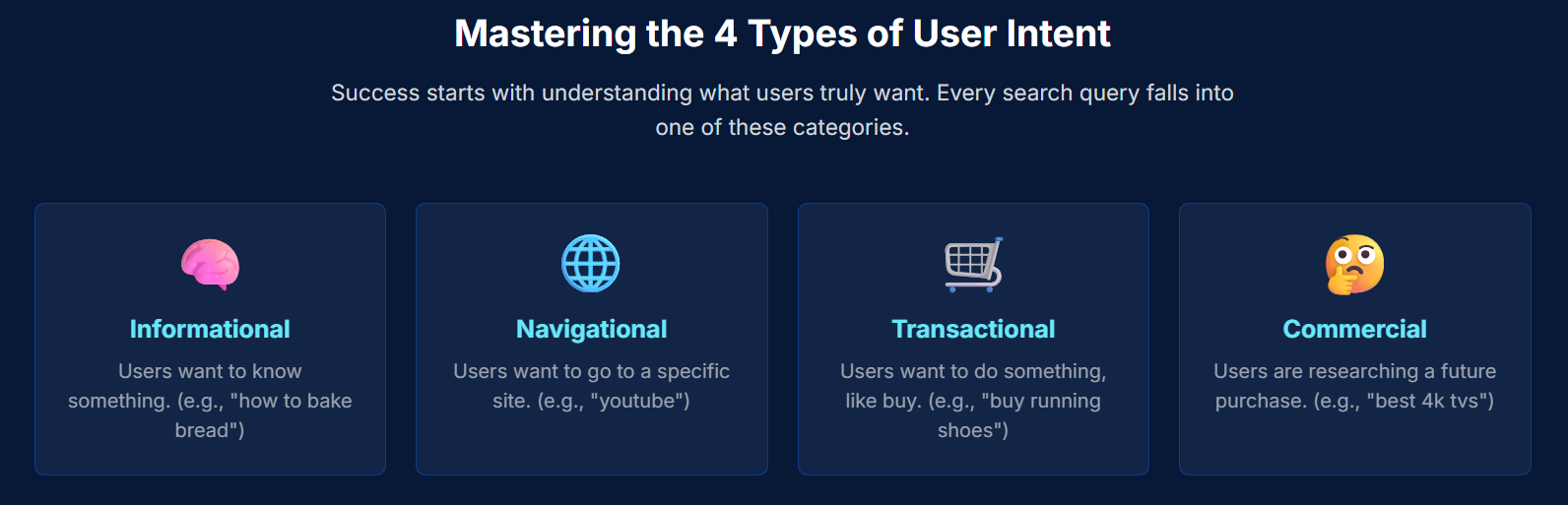
The sheer size and variations of online searches demand more sophisticated user targeting, which can be effectively addressed with a user-focused SEO strategy. An effective SEO strategy addresses three key challenges: keyword classification, content alignment with user’s needs, and providing value to user.
- User Intent Issue
Web content cannot be a one-way street anymore. Suppose your SEO strategy does not target specific users (by identifying them through specific keywords in search engine queries) and does not create engaging, trustworthy content for them. In that case, it won’t be ranked highly by search engine algorithm lords.
- User Intent in SEO
Let’s understand what a User-Focused SEO Strategy is all about with a simple example.
Ex 1. For a tech-review website, the focus is on informing users to make better decisions, discover new insights based on their interests, and promote product discovery.
Users’ search query on Google: Best Phones under $5,000 / Best Phones to Buy in 2025
An SEO strategy targeting such users will include content featuring a list of phones, along with their specifications, photos/videos, price information, and expert review commentary on the products. Additionally, the webpage will also share related posts or content on topics such as phone cases, digital accessories, upcoming phones, and product reviews.
What the webpage won’t include is a list of phone models that do not meet the user’s search criteria. This includes phones over $5000, or way under that amount, and phones not available for purchase in 2025. Omitting any of the above information, such as specifications or prices, will also lead to a high bounce rate, as users prefer a webpage with comprehensive information rather than visiting several pages to collect scattered information.
To create a great User-Focused SEO Strategy, we must first analyze relevant user queries to determine their contextual meaning and then create SEO content that targets the user’s expectations. To ensure a good user experience, websites cannot afford to give inaccurate, incomplete, or misaligned data, and neither can they stuff the page content with keywords like phones to buy ” without proper context.
A1. What is User Intent?
In simple terms, user-focus, search-intent, or user-intent is about addressing the user’s needs. In the context of Google, this translates to matching search engine results with users’ expectations based on their search queries. In the context of website SEO, this means creating content for users on your website that perfectly addresses their expectations and delivers a little extra.
This leads to an improved user experience and aligns perfectly with Google’s policy of ‘Value to User.’ Thus, given that all other metrics are good, Google will rank this ‘helpful’ page higher than others, subject to domain authority, the accuracy of the information, and user behavior on the webpage.
As you may have guessed by now, recognizing user intent through search queries will play a big role in deciding your SEO strategy. This addresses a crucial question for website creators: Why is the user searching for this information? To simplify understanding, Google has categorized user intent into four broad categories.
A1.1 The Different Types of User Intents (Broad Classifications)
According to recent data, Google receives over 5 trillion search queries annually, which translates to a daily average of approximately 5 million queries. (Source)
This huge volume of search is quite difficult to categorize; however, on a broader scale, it’s possible to do so. Thus, Google released its Search Quality Evaluator Guidelines, which provide helpful guidelines for classifying user queries into four broad categories.
| Google Intent Category | Keyword Intent Category | User Goal |
| Know | Informational | Seeking knowledge or answers – The user wants to learn more about a particular topic. |
| Do | Transactional / Commercial Investigation | Completing an action or researching before a decision – The user wants to take a specific action or engage in a particular activity. |
| Website | Navigational | Finding a specific website or webpage – The user is looking for a specific website or webpage. |
| Visit-in-person | Navigational/Local Search | Locating a specific business or category to visit – The user is searching for a particular business or location to visit. |
The key difference between Transactional and Commercial intents – Commercial intent signifies the early stage of decision making, and Transactional intent shows the user is ready to take action.
Let’s see how keyword categorization helps in understanding user intent through an example.
- Same Keyword, Different User Intents
Let’s examine how user intent may vary for the same set of keywords.
Main Keyword: alcohol
Keyword Modifiers: buy, shop, delivery, cocktails, best, cheap, brands, store, near me, uses, types of.
Step 1: Analyze the main keyword – A search for ‘alcohol’ could mean different things, such as rubbing alcohol, wine, beer, whiskey, or any other alcoholic beverage.
Step 2: Define Relevant Intent – Select the possible meanings for alcohol queries you want to target. For a beer manufacturer, this will mean beer; for a winery, it will mean wine; and for a chemicals supplier, it will mean rubbing alcohol or cleaning solutions.
Step 3: Identify Search Modifiers – Buy, Delivery, Cocktails, Best, Cheap, Brands, Store, Near Me, Uses.
Step 4: Derive user-intent – Combine Main Keyword + Intent Specific Keyword
| Keyword Combination | Intent Type | Target Businesses & Content Types |
| Alcohol + Buy | Transactional (Signifies Readiness to Buy) | E-commerce stores, supermarkets, retail chains, alcohol brand pages, chemical suppliers |
| Alcohol + Buy + Near Me | Transactional + Navigational | E-commerce stores, supermarkets, retail chains, local store locator pages, and Google local listings |
| Alcohol + Best | Informational | Blog posts, product comparison pages, online communities (e.g., Reddit, Quora) |
| Alcohol + Cleaning + Brands | Commercial Investigation | Chemical suppliers, product pages, cleaning product e-commerce stores |
| Alcohol + Cocktails | Informational | Cocktail recipe blogs, bartending guides, beverage brand sites, online communities |
| Alcohol + Delivery + New York | Transactional + Local (Geo-specific) | Alcohol delivery platforms, local liquor stores, e-commerce websites, Google Maps listings (New York) |
Let’s understand each of these user-intent classifications with some practical examples.
A1.1.1 Informational Intent
Users searching the internet to enhance their knowledge use informational intent keywords, such as “how-to,” “why,” “what if,” “what are,” “how is,” “explain,” “uses of,” and “describe.”
Content types that address this intent include Guides, Listicles, Detailed Articles on any topic, data and facts, blogs, user guides, explanatory videos, PDFs, and social media posts.
Types of content(media types): Text, Audio, Video, Images, Fact sheets, White papers
A1.1.2 Navigational Intent
Keywords aimed at directing the users to a specific location on the web.
Users searching for a specific web page of a company, brand, publication etc. It may also include social media profiles and sign-up/login pages.
Ex: Amazon, Facebook, Gmail Login, PayPal, LinkedIn Login, Netflix Sign In, Instagram Profile, Twitter Home, Bank of America Online Banking, Outlook Webmail.
A1.1.3 Transactional Intent
Users intending to undertake a transaction such as buying, renting, selling, subscribing to a service, or shopping.
Associated links or pages designed to complete a transaction.
Ex: Buy Tickets for XYZ, Book XYZ Airlines Ticket for A to B, Buy XYZ Product, rent a room, download games/Software, Donate to XYZ, Enroll for XYZ, Purchase Services.
A1.1.4 Commercial Investigation Intent
Users looking to consider information on a product/service, or subscription for purchase/rent, or other purposes. The intent to take action (buy/rent/sell) is not yet specified.
Web content that caters to this type of search includes Product Comparisons, Product Reviews, “Best Of” Listicles, Business Reviews, Deals and Offers,
Ex: Best phones under 50K, List of Hotels in Bay Area, Best Headphones for DJ, Cocktail mixers, Homemade Pickles, Top rated café in Amsterdam, Best courses in Python.
A1.1.5 Visit in Person
Keywords that specifically demand information about a place or business, or seek direction and information about going to a particular place.
This includes local area searches, searches for specific places such as museums, searches for business hours and addresses, searches for visiting addresses for professional services or offices, and map locations.
Ex: Searches with place-name like National Parks, Museums, etc. Direct location searches include Google HQ, National Highway, Domino’s on Park Avenue Street, Post Office in Manhattan, and the Bay Area, California.
A1.2 Going Beyond Basic Classification of User Intent
While the content types discussed above serve to broadly categorize search queries and keywords, they are not an exhaustive list.
A good intent–discovery strategy will require an empathetic, flexible, pre-emptive, and sophisticated approach to user-intent classification.
Minor nuances, users’ emotions, users’ journey, users’ end-goals, and varied user-intents can result in more complex categories.
For instance, a user query for ‘continental cuisine’ might include any of these:
- A list of nearby restaurants offering continental cuisine
- A guidebook on elements of continental cuisine
- A step-by-step walkthrough on making a continental cuisine
- The history of continental cuisine
- An image or video of what a continental cuisine looks like
- Interesting facts about continental cuisine
- A definition of continental cuisines
The list will continue to grow. Therefore, it’s best to apply user-intent modelling techniques that help pre-empt the intent cluster and create relevant content to satisfy the user’s queries completely. Now that we have learned what User Intent is all about, let’s see how it drives a successful User-focused SEO strategy.
A2 Why User Focus is Critical in 2025
Changing user expectations, AI-led disruptions, and Google’s policy on content relevancy in search rankings have brought user-focused SEO to the forefront.
A2.1 Avoiding the Keyword Research Trap
The simpler, earlier version of SEO keyword strategy primarily focused on using keywords with high search volume. This strategy ensured that websites attracted more visitors, but beneath the surface, it hid a critical flaw.
Since marketers overlooked user intent, their visitors were often not aligned with their product or services. The result is a high bounce rate, low conversion rates, and ultimately lower SERP rankings (remember, Google evaluates webpages based on their relevance, usefulness, and good user experience).
This situation was called the ‘Keyword Trap.’ Google is quite transparent about how its sophisticated search engine ranks a page’s relevancy and matches it with user queries. Most SEO experts today understand that using keywords based on user intent avoids the pitfalls of ‘Keyword Trap’ and ensures a more satisfying user experience. It also helps websites lower their bounce rates (as visitors stay longer due to relevant information) and boosts the conversion rate of visitors.
A 2.1.1 How User Intent-Based SEO Optimisation Solves Keyword Trap Issue?
Optimizing your SEO strategy based on user intent helps you avoid the pitfalls of keyword traps. It focuses on relevance and avoids forced targeting of high-volume keywords that do not quickly convert visitors into customers. On the contrary, it targets users specifically looking for information on products and services.
Since a large factor in Google quality guidelines is ‘helpfulness’ (to users), user-intent-based SEO strategies ensure that your web content provides well-structured, trustworthy, and to-the-point information on specific queries. This not only helps increase your website’s usefulness to the user but also builds trust, since you don’t use generic content to boost your SEO rankings (which can be very disorienting to a focused reader). Please note: You don’t want to distil your keywords too much. Users casually surfing for one particular information are most likely to be interested in related information, even if it takes them away from their initial query. The balance between broad reach and hyper-specific targeting must be maintained to maximize the benefits of a SEO keyword strategy.
A2.2 Evolving Search Engine Algorithms and AI Influence
In 2025, the year when Google pushes the gas pedal on its AI search tools, Generative Engine Optimization (GEO) is no longer an option, but a priority for business visibility. To understand how Google is fast-tracking AI applications in online search, making them more sophisticated and intent-specific, we have to understand where it’s coming from and where it’s headed.
A2.2.1. Google Algorithms
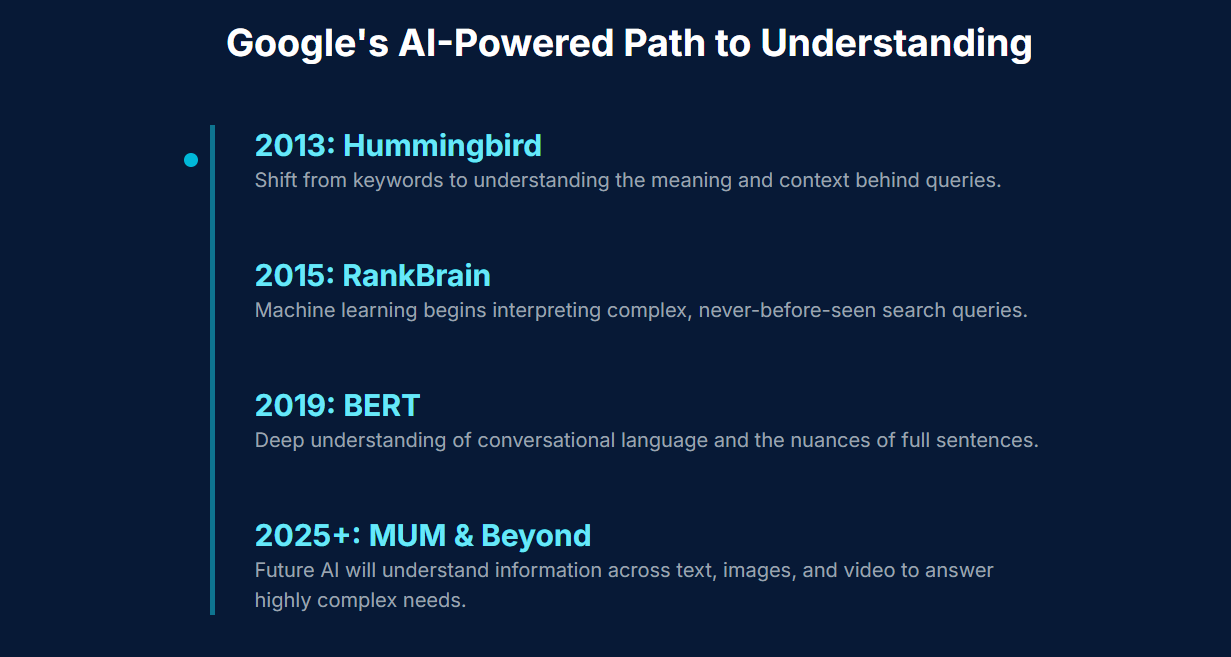
The launch of the Hummingbird algorithm in 2013 marked Google’s shift to the semantic search principle (contextual interpretation of search queries) from the keyword-matching technique in search results. Previous updates, such as Panda and Penguin, were mere add-ons to its keyword-based data filtration technique, but Hummingbird initiated a whole new paradigm. This development was in sync with the development of underlying technologies, including Machine Learning, Data Science, Natural Language Processing, and advanced algorithms.
The immediate effect of the Hummingbird algorithm was the shift from keyword matching to content relevancy and quality search engine results for users. Subsequently, Google rolled out its first machine learning component, RankBrain, in 2015, which enabled it to interpret complex search queries more effectively, aligning search results with user intent more strategically.
In the series of these developments, the next big wave of change was created by Google’s BERT, an ML-NLP-based algorithm, in 2019. BERT has had a significant impact on how Google utilizes SEO, as it now has the ability to comprehend long and conversational queries. Which meant that it could now understand full phrases and sentences rather than isolated keyword groups, and thus its ability to interpret had taken a massive leap.
Adding to Google’s already powerful search engine were capability enhancements, such as Computer Vision (integrated by 2020) and evolving voice search features (2011-2025). In 2025, Computer Vision powers tools like Google Lens, which makes image recognition and search highly effective. Similarly, advanced voice search capabilities in more than 70 languages have made this feature highly popular among users in 2025.
A recent report indicates that 30% of internet users aged 16-64 utilize a voice assistant at least once a week. Source: Digital 2024 Global Overview Report
For SEO strategies to adapt quickly to these changes, it is important that we understand how each of these search mediums generates slightly different queries. For instance, people tend to ask questions differently when writing as compared to when using voice search.
Writing Search: Halloween celebrations date / best Italian restaurants in NYC reviews and timings
Voice Search: When do we celebrate Halloween? / what’s the highest-rated Italian restaurant near me that’s open now?
A2.2.2 Evolving Semantic Search Capabilities and What it means for SEO strategy?
For starters, this means that your SEO strategy must be geared towards content generation that picks up on nuances (avoiding generic content), provides value, and establishes trust. The ideal way to do this is to anticipate various sources for queries apart from search engine keywords like long-tail queries from voice search (how do I make my cat take medicine?), location specific queries (pizza in Italy vs. pizzeria in New York), or questions appearing at various stages of user’s journey into the subject of interest (what’s the best phone in 2025? vs. what’s the best android phone above 125 Hz refresh rate available under 50K in 2025?).
Another interesting trend we have observed relates to Google Ads search statistics.
A report published in July 2025 revealed that the conversion rate of Google Ads for shorter queries (1-2 words) decreased from 76% to 50% by June 2025. Simultaneously, for longer queries (3-4 words), the conversion rate increased from 20% in January 2025 to 50% in June 2025. Source: Search Engine Land This data clearly depicts that Ad conversion rates are being skewed towards longer, less generic queries, which is a strong hypothesis in support of the observations made earlier about evolving semantic search capabilities and the increasing role of natural language-based query usage in searches in 2025.
B. Why Focus on AI for a Powerful SEO Strategy?
“AI isn’t here to replace traditional SEO; it’s here to enhance it. The key is to start experimenting, stay informed, and always prioritize delivering value to your audience.” – Forbes.
The increasing role that AI is going to play in our internet use is undeniable. However, for early movers, this presents a unique opportunity to get ahead of their competition and benefit from a generational shift in technology.
For developing a strong SEO strategy in 2025, the applications of AI in search need to be carefully studied. Trends reveal that searches are becoming increasingly long-tailed, conversational, and strongly intent-driven with the rise of of LLM models, Voice Assistants, and Voice Search. This invariably calls for a change in the ways we create content and for SEO purposes.
As search engines become increasingly capable of understanding the context behind search queries, search results become more natural and relevant. To rank higher in such search results, businesses need to ensure that they are creating varied, rich, and practical content for their target users. Elements such as listicles, guides, step-by-step walkthroughs, opinionated articles, expert commentaries, user reviews, and audio and video media will become increasingly important in this scenario.
- Google’s upcoming MUM algorithm
While businesses prepare to adapt their SEO strategies to these recent changes, they must also consider the upcoming Google Algorithm, MUM (Multitask Unified Model), which is expected to be approximately one thousand times more intelligent than BERT. This means that MUM can understand different languages, texts, images, and videos like a superhuman brain. It would be able to map out a user’s journey (at what stage of search the user is about a certain topic), their motivations for that search, and potentially gain a fuller contextual understanding of the user’s search request.
For example, if you search for ‘best affordable tooth cavity surgeon in San Francisco Bay Area,’ it would be able to:
- Intent: Understand my need for a tooth cavity, and show only cavity specialists, not generic dentists.
- Location: Show only dental professionals in the localized area, not all of San Francisco
- Specific information: Show only surgeons and not dentists.
- User Journey: Recognize that you are in the preliminary stage of your online search, so it displays appointment links, prices, and reviews rather than detailed information about the surgery process.
- Nuances: It would only show dental surgeons who are reviewed or mentioned as affordable.
- Multi-modal results: As long as it meets the above criteria, it will display text, images, audio, and videos from dental surgeons or clinics, providing richer audio-visual information.
B1 Generative AI – AI Overviews and Google AI Mode Adapting SEO Strategy to New Search Engine Dynamics
- Generative AI – Tools like ChatGPT, Gemini, and Co-Pilot are likely to take over a large percentage of search traffic in the coming years. Their multi-modal capabilities and user-friendly interface make them an excellent tool for conducting conversational inquiries and web searches.
- Google AI Overviews – This feature, launched in May 2024, appears at the top of search results and gives a summary of information related to the user’s query. However, this is mostly applicable to informational intent-based queries, and commercial/transactional queries have a lower chance of an AI overview mention.
One way to leverage this feature is to create informational and helpful content that explores a topic in depth. This will ensure that Overview adds a link to your page (from which it has taken the information), and users can visit your webpage to explore their interests further. Crafting in-depth, well-structured content based on long-tail keywords increases the likelihood that your content will be picked up by Google. Overview- something that we expand on later in the blog.
Some interesting implications of AI Overview for Search Engine Results:
- Links ranking at the top of page 1 results (where AI Overview is active) showed a 34.5% drop in CTR (click-through rates), indicating that users’ queries are increasingly being satisfied by “zero-click searches,” and organic traffic is dropping rapidly for informational queries. Source: Ahrefs
- As a result, websites and businesses are trying to reframe their content strategy (including SEO) to feature more and more in AI Overviews, to increase their organic traffic.
- On the contrary, pages that did not rank on the first page of search engine results now have the chance to be featured in Position Zero (above all links) if they play their cards right, i.e., they create helpful, valuable, and AI-retrievable content.
“In fact, if you put content and links within AI Overviews, they get higher clickthrough rates than if you put them outside of AI Overviews.” Sundar Pichai, CEO Google.
Google AI Mode – Launched in May 2025, this feature integrates an LLM model with Google Search, providing advanced search capabilities for natural-language/conversational queries, as well as multi-modal queries (including image/video/voice-based search). It expands search queries into questions and delivers highly structured, AI-generated responses (including text, audio, graphs, images, and visuals), rather than links, while remembering previously asked questions. Again, for websites, this can and will (once it becomes more popular) result in a drop in CTR and organic traffic.
B1.1 Revelations that put the AI-led disruptions in online search into perspective:
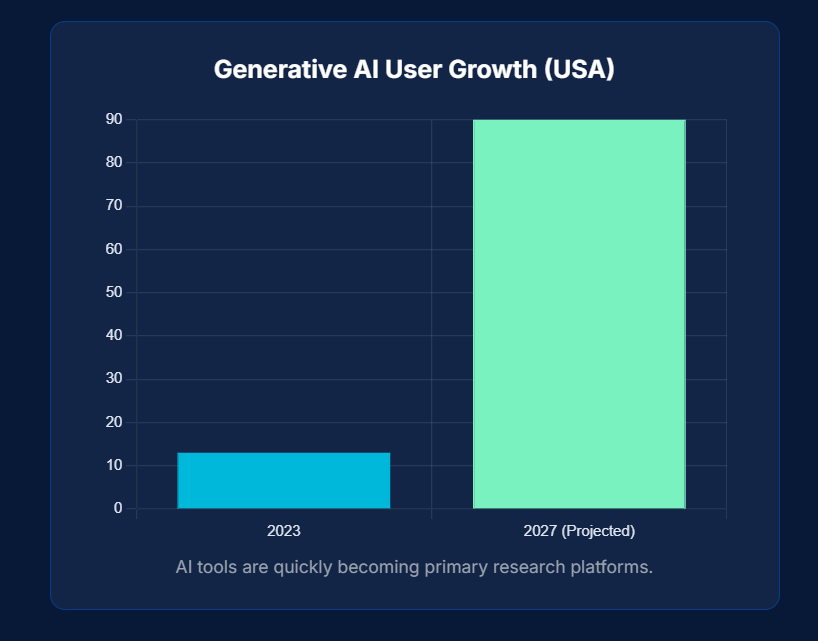
- The number of users in the USA using generative AI tools like ChatGPT and Gemini was 13 million in 2023. By 2027, this figure is projected to be over 90 million, as more and more people start using them as their primary research tools.
- Source: Semrush AI Search Report, Dec 2024
- 20.2% users have changed their primary search platform within the last year.
Source: Search Engine Land
These users are increasingly preferring to conduct their internet searches in the form of dialogues, a capability that generative AI search engines like ChatGPT and Gemini excel at. This will result in a significant shift in user behavior, which marketers must consider when developing their SEO strategy for the future.
B1.2 Experiment
We asked Google AI Mode to list ‘Good Affordable Gaming Headphones” for us. After presenting a list of headphones, summarizing information and links to their respective websites, we asked it to elaborate on the reasons for its choice (from the perspective of a search engine). This is what it revealed:
1. First, it focused on identifying the user intent.
- “Affordable”: Focus on budget-friendly products (typically under $50–$70).
- “Wired”: Eliminates wireless options; focuses on no-latency, plug-and-play devices.
- “Gaming Headphones”: Prioritizes mic quality, positional sound, and long-term comfort.
2. Then it scanned authoritative & relevant sources for data.
- Trusted Review Sites: e.g., RTINGS.com for objective, in-depth comparisons.
- User Ratings & Reviews: Insights from real users on Amazon and other retailers.
- Recognized Brands: HyperX, Logitech, Astro, and Turtle Beach for reliability and popularity.
- Expert Roundups: Consistently recommended products from “Best of” lists and guides.
3. Within these sites’ products, it prioritized key gaming features
- Comfort: Memory foam, adjustable bands for long sessions.
- Mic Quality: Clear, noise-canceling microphones for team communication.
- Sound Performance: Positional audio clarity for in-game cues.
- Durability: Favor products with good build quality despite lower cost.
- Wired Compatibility: Standard 3.5mm or USB support for PCs and consoles.
4. From the available options, it checked which ones have well-structured information and are UX-friendly for information retrieval
- Top Recommendations First: Most relevant choices shown upfront.
- Supporting Context: Helps users understand trade-offs and features.
- Readable Format: Bullets, bold text, and clear organization of information.
You can repeat this experiment for any product recommendation; the end results will be similar. Domain Authority, Good Reviews, Structured Content, Specific Information, and In-depth content that aligns with user intent are key to appearing in AI results. If you enjoyed this brief experiment on intent-matching, we invite you to explore SEOTonic Case Studies here.
B1.3 Increased User Expectations
What do we mean by increased user expectations?
Here’s a fact for you: 75% of smartphone users expect immediate information when using their smartphones, according to a Google research insights review.
Source: Think With Google Research Review.
This fact was published in 2019, and since then, user expectations are bound to have increased, especially with AI tools and search features coming into play between 2019 and 2025.
With attention spans getting shorter, technology becoming faster, and AI making in-depth information readily available at our fingertips, users’ expectations are likely to increase. It’s not only about being quicker, but also about the way this information is presented. Users expect more personalized answers with a seamless experience that integrates multiple media, such as text, audio, images, and videos.
Thus, modern SEO strategies should aim to provide in-depth, customized, and personalized information to prospective customers, leveraging AI search engines and Google’s own AI Search tools.
B1.4 Applicability to All Search Engines (Not Just Google)/ Content Hosting Platforms
In this blog, we have largely discussed Google-specific policies and examples, however, these principles apply to all online platforms. The central principle of ‘value to users’ is applicable to :
a) Search Engines like Bing, Yandex, DuckDuckGo, Baidu
b) Video hosting platforms like YouTube, Vimeo, or Dailymotion.
c) Social Media Platforms like Facebook, Instagram, Reddit, Quora, Pinterest, TikTok
d) E-commerce Platforms like Amazon,
e) App Stores like Google Play, Android App Store, or Apple App Store
f) AI Chatbots and Virtual Assistants like Gemini, ChatGPT, Perplexity, Claude AI
SEOTonic has successfully implemented these strategies for its clients, making us one of the top SEO agencies in India. Our happy users and industry experts have shared their detailed feedback, which you can read here.
C. Key Benefits of User-Intent Focused SEO Strategy
Let’s summarize the key benefits of a user-intent-focused SEO strategy for your business in 2025.
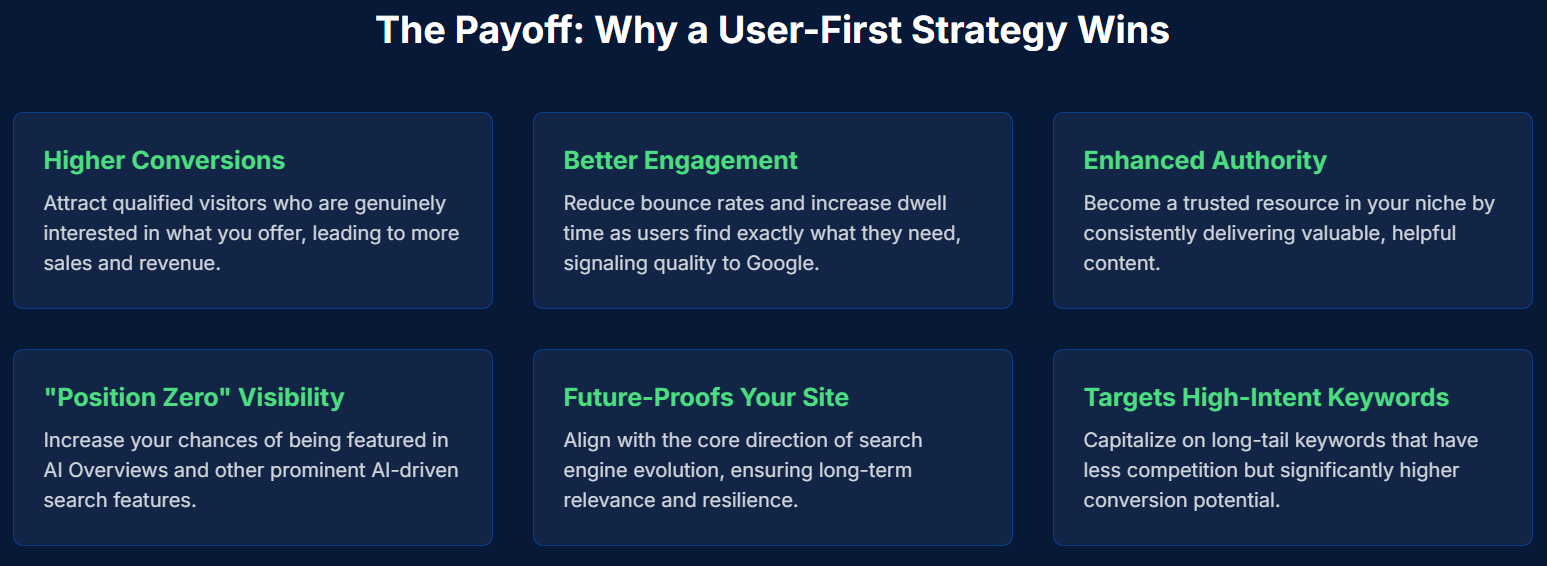
- User intent helps increase organic conversion rates by providing users with valuable and relevant content. Thus, it can potentially boost sales and increase revenue.
- It reduces site bounce rates, increases its dwell time, improves user engagement metrics, and enhances domain authority.
- It leads to higher SERP rankings and opens channels for getting featured in AI components, such as AI Search, AI Overview, AI Mode, AI Features, and Snippets.
- It makes your website future-ready and flexible for search engine developments.
- While high-ranking keywords are tough to compete with, a user-intent-based SEO strategy allows you to diversify your chances for higher SERP ranking through low-volume and long-tail keywords.
Conclusion
Leveraging a user-intent-focused SEO Strategy is not an option; it’s a necessity when it comes to developing a highly effective SEO Strategy in 2025. It perfectly captures the essence of the changing dynamics of the internet and search engines, helping businesses with online presence become future-ready. However, SEO is a big field, and apart from user-intent-based keyword strategy, there are many elements that come together to create a strong and effective online presence. In this blog, the goal is to make the reader familiar with the ‘why’, ‘how’, and ‘what’ of recent SEO developments and suggest ways to benefit from them.
If you are looking for seasoned professionals who understand the ‘ins and outs’ of SEO Strategy, or searching for the perfect agency partners to implement User-Intent SEO strategy, you can reach out to SEOTonic.