
25 July
Uncategorized
The Future of Link Building:Quality Over Quantity in 2025 SEO Strategies
- admin_boi
- 0 Comments
Key Takeaways
|
Blog Audio
Building Backlinks for SEO
Despite the transformations that 2025 has brought about in the way the internet works, backlink creation remains a highly effective (if not the most effective) way to boost brand authority and organic visibility. Those who have attempted to establish a good backlink profile for their websites are familiar with the challenges of undertaking this complex and sometimes frustrating task. This is because most people do not understand that, unlike other elements of SEO, such as creating schema markup or performing on-page SEO optimisation, you cannot simply will quality backlinks into existence. That requires meticulous planning, value-creating, developing relationships, and patiently waiting for the internet to do its magic. Furthermore, the changes in Google’s Algorithms, which increasingly enable the filtering out of truly valuable content from spammy or low-quality pages, make it even more critical for websites to focus on building ‘quality backlinks’ in 2025. While this article focuses on Google, the ideas and principles of link building discussed here apply to all advanced search engines, such as Bing, Yahoo, and DuckDuckGo.
“High-quality backlinks remain one of the most reliable indicators of trust and authority in the eyes of search engines—even as Google’s AI and algorithm updates continue to evolve. — Olga Andrienko, VP of Brand Marketing, Semrush
Before we delve further into link-building strategies, let’s briefly review some key facts and data points to gain a deeper understanding of the current backlink creation landscape.
- There is a deep connection between a site’s authority and credibility, as measured by the number and variety of domains linking to it (backlinks). A study by Backlinko revealed a strong correlation between a site’s link authority and higher search engine rankings. In fact, it found that pages ranked in the no.1 spot in Google had 3.8 times more backlinks than pages ranked 2 to 10. (Source: Backlinko)
- 94% of all online content received no backlinks, while only 2.2% of all content received multiple external links. (Source: Backlinko)
- About 52% of Digital marketers believe link-building is the most difficult part of SEO. (Source: Authority Hacker)
- The average time it takes to see link-building results on SEO is 3.1 months. (Source: Authority Hacker)
- 65% of digital marketers and SEOs recognize domain authority as the most important factor affecting backlink quality. (Source: uSERP State of Link Building)
Why Backlinks Are the Backbone of Your SEO?
If you are new to the term, backlinks are the result of your link-building process. Link-building is how you get other websites on the internet to connect with yours, if they find your content, service or mentions useful for their visitors. Your name being mentioned on another website (through link insertion or hyperlinking) creates what is called a backlink. A backlink signifies trust between two internet entities. It builds a network of valuable webpages, which translates for Google search algorithms as a vote of confidence. This enhances your ranking and relevance in search engines, which is reflected in improved SEO scores and SERP results. Thus, building high-quality backlinks is crucial for standing out among competitors and gaining more trust, popularity, and credibility from search engines.
What is the ‘Quality’ of Backlinks?
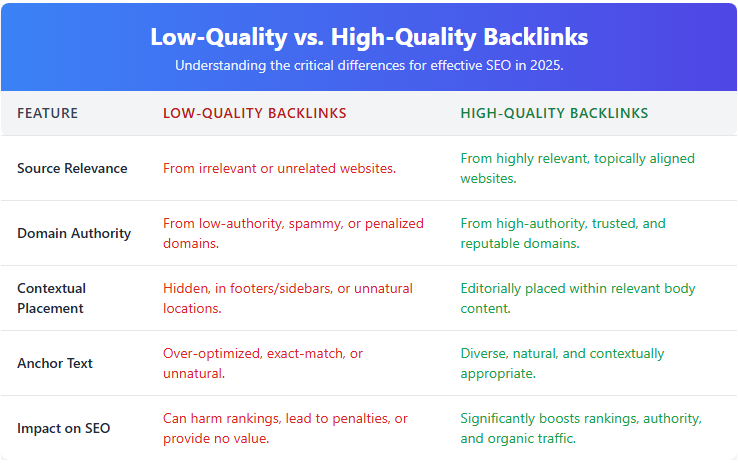
There are many websites on the internet, but not all are trusted (E-E-A-T), valuable or topically relevant to your domain. A single backlink that your website received from a highly trusted, relevant and high-authority webpage has more weightage for search engine algorithms than several backlinks from low-trust or irrelevant webpages. So, the quality of backlinks depends on the type of association (valuable or detrimental) that your website forms with another website, based on different factors like the source website’s reputation, its relevance, its website authority, link placement, and natural text anchoring (how your link is mentioned w.r.t the context of the webpage) etc.
Why are high-quality backlinks important?
PageRank was the original Google framework that ranked websites based on the quantity and quality of inbound links to their webpages. However, the current Google algorithm is built on it. It incorporates multiple features and hundreds of factors, such as content quality, user experience, mobile friendliness, and website technical aspects, to determine the value of your webpage. High-quality backlinks are one of these crucial factors. They signal your website’s legitimacy and authority; the more such backlinks it accumulates, the higher the chances are that Google will rate your content valuable and give it preference in search results. Thus, creating high-quality backlinks is crucial for enhancing your website or webpage’s online visibility (SERP and AI results) and plays a significant role in establishing your brand authority.
What are the forces driving the change in Link-building Strategies in 2025?
As Google constantly upgrades itself and the way it ranks, rates and classifies online resources, many technological factors must be taken into account to create a robust backlink-building strategy.
Google’s Evolving Algorithms and AI
Google algorithms have become increasingly sophisticated over the last decade, thanks to the application of Machine Learning algorithms and, more recently, advanced AI models like generative AI. These AI models have improved Google’s capability for Smarter spam detection, contextual understanding, pattern recognition, and semantic relevance (understanding user intent and content value). This makes it more capable of identifying low-quality, spammy or illegitimate link-building processes. It also actively targets and penalises such practices to ensure a better user experience and provide greater value to users through online search results.
- Google’s Perpetual Updates: Updates like Penguin, SpamBrain, and the more recent 2024 update reflect Google’s ongoing efforts to identify and eliminate link spam, low-quality or spammy backlink directories, and artificial linking schemes. This has shifted the focus from the quantity of backlinks to their quality, signified by the credibility, authority, and relevance of backlink sources.
- Need for Legitimate, High-Quality Signals: Updates like Helpful Content that prioritizes user-first content, and AI Overviews/Google AI Mode, which has changed how information is presented, indirectly reinforce the need for legitimate and high-quality signals, such as backlinks. These updates contribute to Google’s efforts to devalue manipulative link-building tactics.
- A Shift from SEO Authority to Multi-Platform Authority: While earlier the focus was more on developing a strong SEO profile, the goal of link-building today is much broader. Today, the focus of backlink creation is to build comprehensive digital authority. This means that while strategic backlink acquisition remains vital for your website’s search performance, it also contributes to your brand’s overall discoverability across diverse platforms The machine plus human discovery approach has also ensured that unlinked mentions of your brand/website, and co-citations (when your brand is linked to other brands or topics) also factor in to building your brand value and its topical authority.
The “Hint” Update for Nofollow
There are four link types: ‘nofollow’, ‘dofollow’ and the more recently introduced rel=”sponsored” (for advertisements or paid placements), and rel=”ugc” (for links that come from user-generated content (e.g., comments, forum posts). Initially, ‘dofollow’ links signalled to Google that link equity or link value can be transferred between source and linked pages, and ‘nofollow’ links stopped Google from transferring link equity between them. The concept of transferring link equity helped Google map out a network of related addresses, creating a web of information and resources on the internet.
However, with the new update, Google has notified that it might still crawl ‘nofollow’ links to improve its understanding of the domain and ranking purposes. This way, its smart algorithms will improve its understanding of web connections and help identify spam links better. What this means for websites is that even a ‘nofollow’ link on another site might help Google better understand your domain, its context, and potentially contribute to its perceived authority.
Thus, today backlinks of all types have become even more crucial for a comprehensive SEO strategy. They provide Google with more sophisticated signals that go beyond direct link equity and contribute to increasing overall brand visibility, helping to achieve SERP goals.
User Intent and Experience
There has been a gradual shift in how Google approaches content. Its ‘value for user’ principle has taken shape into a user-intent and user-experience focused approach in search results. High-quality backlinks demonstrate good user-intent fulfilment and user satisfaction to Google, and thus, having them on your website also enhances your website’s value.
Low-Quality Link-building and Google Penalties?
Google constantly monitors or audits your backlink sources, patterns and changes. To reduce and discourage people from using manipulative link-building techniques (‘black-hat’ techniques like link buying or selling or joining link farms, etc.), Google Search Essentials (previously known as Google’s Webmaster Guidelines) outlines acceptable practices. Any violation of these can attract penalties through Google’s algorithmic or manual audits of your website.
These penalties are rarely monetary in nature, but can result in the de-indexing of your website (complete removal from search engine results) or a significant lowering of its ranking. This will mean the end or a significant reduction in organic traffic flows. A reconsideration request to Google in such matters may take some time to be resolved, and addresses, which means potential losses. These regulations, combined with the high cost of non-compliance, underscore the importance of ethical and high-quality link-building practices.
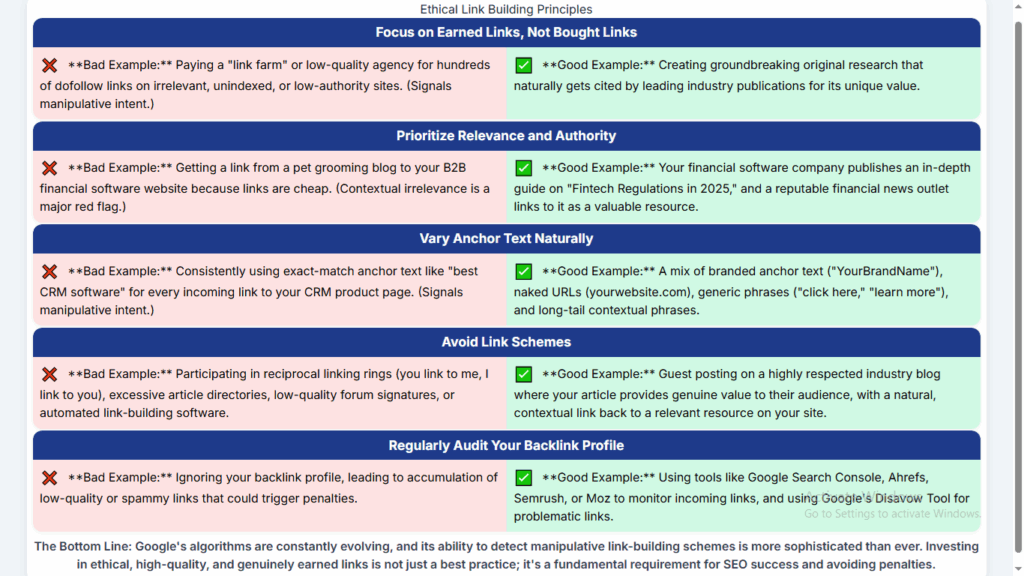
The image below outlines some good link-building principles, as well as those that you should avoid to ensure you don’t attract negative scrutiny or costly penalties.
To ensure that your business receives the hype and online clout it truly deserves, you can make SEOTonic your SEO partner. We offer highly effective, result-oriented, and affordable SEO services in India and globally.
The Definition of Quality in Link Building in 2025
Quality backlinks and how Google perceives and uses them form the core of its free and fair competitiveness approach to internet searches, while providing a method for different players to grow and expand in a competitive space. Thus, the definition of quality link-building is integrally tied to Google’s understanding of the web, the functioning of its algorithms, and its principles on ranking different sources of information on the web.
- The most important factor that makes any backlink “high quality” is its relevance. The source and destination of the link must topically align to be considered a valuable endorsement.
- For example, A backlink from a travel blog to a tour company is highly relevant. Similarly, a backlink from a hotel booking company to the “Facilities” page of a hotel chain website is also relevant. When LLMs and AI tools come into play, such relevant backlinks help your brand name align with key topics associated with your domain, resulting in improved domain/brand authority.
- Any backlinks from a low-authority and low-trust domain will negatively impact your link equity. This is because Google works on the E-E-A-T framework (Experience, Expertise, Authoritativeness, Trustworthiness). These principles outline the fact that endorsements are only valuable when they come from credible, high-trust and verified sources. Newer websites with low authority are an exception to this rule, unless they’re also low on the trustworthiness factor (by being spammy or placing links unnaturally).
- A high-quality backlink is linked with high traffic flow. It links a high-traffic source website (where it is added) to the linked source (where it points to). This results in a flow of valuable referral traffic from one high-quality page to another, thereby adding value to a user’s online experience.
- The placement of links also matters a lot. Links placed in the centre of webpages have heavier weightage than those placed in page footers. Additionally, the method of inserting a link also affects the quality of a backlink. Well-inserted links that align with the source page’s context and content are called Editorially placed links, and are better integrated than randomly placed links.
- Good link placements are recognized by search algorithms as naturally placed links, signaling the utility and contextual relevance of the backlinks. The algorithms prefer such links as they help avoid over-optimised or exact-match anchor text (unnatural placements), which signal poor link-building practice.
- The technical health of a website (site-health) reflected by structure optimization, page speed, lack of spam, good SEO scores, and clean design, also helps links placed naturally in it appear high-quality to the search algorithms.
Why Quantity over Quality is a Bad Bargain for Link Building Strategy in 2025
Let’s now examine some of the detrimental effects of prioritising quantity over quality in backlink building strategies in 2025. Please note that, in general, we consider high-quantity backlinks to be of low quality.
- The presence of many low-quality backlinks on your website might result in a drop in your website’s credibility and search engine ranking.
- Since Google algorithms are designed to give preference to high-quality backlinks, your competitors may benefit more from one high-quality backlink than you would from 100 low-quality ones. (The number is hypothetical/conjectural.)
- Acquiring backlinks from non-relevant domains can result in a decline in your website’s domain authority.
- Links generated from low-quality and superficial content will not result in high-quality backlinks, as Google perceives such content as having low user value. Thus, backlinks from such content will again be detrimental to your website’s trustworthiness and authority.
- A low variety in link keywords, resulting in a high number of backlinks with the same anchor text, is also a negative indicator for your website and may signify unnatural link-building practice that can attract penalties.
- Local SEO and links related to such content have a higher opportunity for conversion and improving the relevance factor. Preferring non-local domains in high quantities over locally relevant domains may result in a case of missed opportunity.
- A major source of getting quality backlinks is to develop professional relationships and network within your domain. Ignoring this method for obtaining well-placed editorial links for bulk link building is a losing game.
- Ignoring contextual placement of your links and placing them arbitrarily without context (as seen in practices related to bulk link acquisition) also lowers your backlink quality.
What Are the Advanced Tactics for Quality Backlink Building?
Let’s explore some effective and ethical strategies for acquiring backlinks.
Link Inserts with a Tiered Strategy
The keyword competitiveness factor plays a huge role in link acquisition strategy. Randomly creating backlinks/link-inserts will not result in any significant SEO improvement, especially for highly competitive keywords. Thus, a link insert can be divided into five tiers, depending on their contextual placement, naturalness, domain E-E-A-T, and topical relevance.

Most backlink creation agencies avoid Tier One link inserts, and experts prefer link inserts over Tier 3. Content curation is a more effective way to place links, as it provides greater control over content relevance and quality.
Content-based Link Acquisition
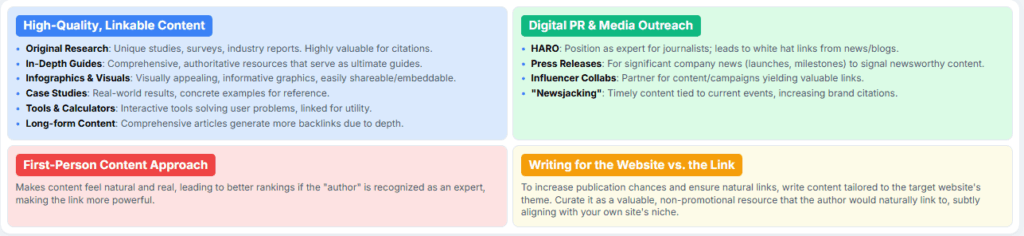
Effective link-building is best achieved by creating high-value, helpful, and relevant content that naturally attracts interested users or partners who desire to associate with the content. Below are different content types that assist the high-quality link-building process.
Advanced Link Acquisition Techniques
Advanced, high-quality link-building techniques require out-of-the-box thinking. There are many opportunities to build valuable backlinks, as shown below:

Building, Growing and Managing Link Profile
Link-building is an ongoing and dynamic process that demands regular maintenance to ensure existing links remain live and valuable, innovation to adapt to evolving search engine algorithms and content trends, and diligent oversight through consistent monitoring. This proactive approach involves strategically adding new and high-quality links to expand your digital footprint. Additionally, one must disavow toxic or low-quality links that could harm your site’s reputation. By actively managing these aspects, you ensure your link profile remains robust, healthy, and continuously optimized for sustained SEO success.
Here are some effective ways to build links that require strategic management and accurate assessment of opportunities.

How can AI help in Link Building?
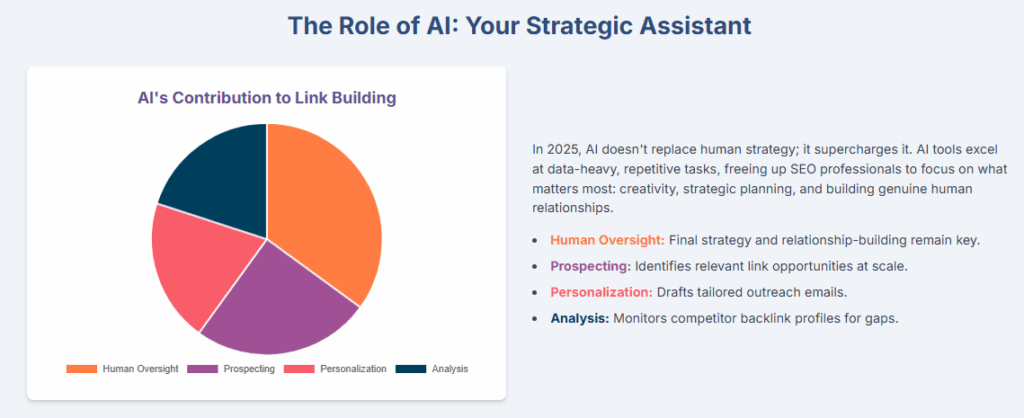
AI tools have the potential to change and revolutionize the way we create backlinks. They augment human efforts when done with strict oversight and strategic thinking. Here are some ways in which you can use AI to support your link-building process.
- Prospecting: AI tools can help you identify prospective websites that match your relevancy and authoritative criteria at scale. The operation supports tasks like competitor backlink analysis and identifies risky domains that could compromise your site’s credibility.
- Outreach management: Since networking and reaching out to potential partners in your domain is a highly beneficial way to acquire valuable backlinks, AI tools can help automate the task, including messaging, automated responses, managing and analysing engagement metrics, and sharing compensation plans for content creation, PR, or sponsorships.
- Empowering Content Creation: Since creating valuable, relevant and new content is a great way to acquire backlinks, AI can help you accelerate your content creation processes.
- AI Tools for Link Monitoring and Risk Detection: AI tools offer great value by automating these processes, eliminating human error, and providing results at scale. Thus, they can safeguard your link profiles and save you from potential penalties.
- Anchor text optimization: Optimizing your link texts/keywords remains a crucial task, which at scale may become difficult, and make you susceptible to anchor-text overoptimization. This shall result in devaluing your link value or domain credibility. AI can help you create innovative and varied anchor texts, which helps you avoid triggering Google’s spam algorithms.
Conclusion: The Future is Here, but Are You Prepared?
In 2025, backlink building is still as crucial for your SEO as it was before. However, the way you approach the process has changed in the last decade. Today, it is crucial for websites to invest in white-hat techniques that help them acquire high-quality backlinks and improve their reach and credibility on search engines. The old ways of link acquisition, which focused on quantity backlink creation, no longer work and may even be counterproductive, as they attract negative scrutiny or penalties. By following the techniques discussed in this article, you can ensure that your web presence grows stronger each day without compromising your credibility and domain authority. A major point to note is that link-building is not a one-off event but an ongoing activity that requires you to invest resources, undertake networking and strictly follow Google’s basic guidelines for ethical link-building. As we prepare to adapt to the rapidly changing internet with the onset of AI and LLM technologies, building a strong foundation for your website backlink profile is never more important than today.
SEOTonic, one of the leading SEO agencies in India, can help you achieve your backlink creation goals by providing expert help with link-acquisition strategies and conducting regular monitoring of your link profile. So, what’s holding you back? Reach out to us and book an appointment with our leading SEO experts today.